Outdoor Scene Puzzle Set offers a refreshingly simple experience for young children. The bright, outdoor-themed artwork is appealing, and the drag-and-drop controls are responsive even for small fingers. By removing timers and scores, the game creates a stress-free environment where kids can develop spatial reasoning and attention to detail at their own pace. The variety of puzzle difficulties ensures the game remains engaging as skills improve. It is a wholesome, educational activity that feels more like play than practice.
Players are presented with a collection of mixed pieces that must be arranged to form a complete picture. Each piece can be dragged into place using a mouse or touch input. When a piece is positioned correctly, it locks into position, providing clear feedback. The game encourages working from the edges inward, matching colors and patterns to gradually reveal the full image. This straightforward mechanic makes it easy for beginners to understand while still offering a satisfying challenge.
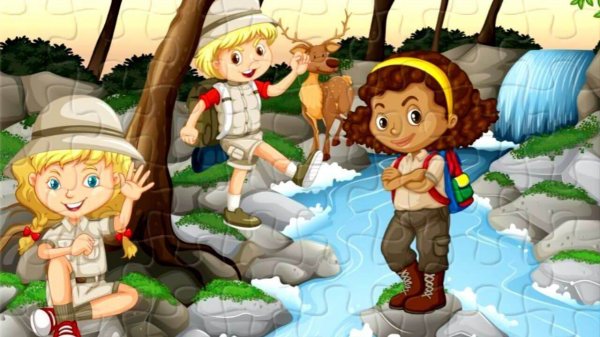
The artwork features bright, friendly illustrations of outdoor settings. Tents, trees, campfires, and other nature-themed elements appear in each puzzle, drawn in a style that appeals to young children. The consistent outdoor theme ties the puzzles together, creating a cohesive visual experience. Colors are vibrant and distinct, helping players identify where pieces belong based on hue and pattern.
The interface is designed with small children in mind. Controls are simple and responsive, requiring no reading skills to navigate. The absence of timers and scoring removes any sense of urgency, allowing players to take as much time as they need. This makes the game suitable for children who are still developing fine motor skills or who may feel anxious about time limits. Puzzles can be attempted repeatedly, supporting practice without penalty.
The game includes puzzles of varying complexity. Beginners can start with simpler images that have fewer pieces, while more experienced players can take on larger puzzles with more intricate details. This range ensures that the game grows with the player, offering continued engagement. A progress indicator may show how many puzzles have been completed, giving a sense of accomplishment without competitive pressure.
Assembling puzzles helps develop several cognitive abilities. Players practice spatial reasoning as they figure out how pieces fit together. Hand-eye coordination improves through the precise dragging and dropping of pieces. Attention to detail is sharpened as players compare colors and shapes to find matches. These skills are built naturally through play, without explicit instruction or drills.











Player Comments
Sign in to comment
You must be logged in before posting a review or rating.
No account? Create one
No comments yet. Be the first to comment!